Oxnard to Summerland
I had to talk about and visit Oxnard a few times before I could say it without an accompanying snicker or an urge to pluralize the name. Did I reach a developmental impasse around humor at age eight, or what? As it happens, Oxnard is the most populous city in Ventura County and the 22nd-largest city in California. Big! The City of Oxnard is named for the three brothers whose family, The Oxnard’s, built the American Beet Sugar Factory in 1898 around which the city was planned, developed and, in 1903, incorporated.
For millennia before it was claimed for Spain in1542 by explorer João Rodrigues Cabrilho, the Ventura area was, and continues to be, home to The Chumash people. The Mountain range among which our base camp is situated, the Topa Topa, is named for the Ventureño Chumash word for “reed” or “rush” and true to name, a little dry creek bed that runs through our campsite is overrun with reeds and rushes among numerous other plants that I busied myself identifying, clad, as I was, in my grey cotton pajamas with their pink flamingo print, from which I had to pull off many prickly burrs before I could sleep comfortably.
Jo and I have gotten into the habit of taking five-day trips. A day for travel and setting up or breaking down camp on each end, and three days of walking. When we started our intermittent coastal walk in 2001, we sometimes covered eighteen to twenty miles in a day. Now we shoot for eight to ten. A painful adjustment for me. Once I get in motion, I just want to keep going. But my feet are now prone to plantar fasciitis and have lost much of their natural dorsiflexion (the anatomical movement initiated at the ankle joint that allows one to lift the front of the foot upward so the dorsal surface, the top of the foot, moves toward the shin.) My podiatrist said that I have precisely zero dorsiflexion left in both feet due to my unquenchable desire to walk. But now, my physical therapist says that I’ve earned back five of the ten-to-twenty degree range of motion that most of us bipeds start out with. Thankfully, Jo has her limitations for distance too, so neither of us is left feeling like the culprit in the case of the reduced milage.
I try to find campsites for us right along the coastline, using state parks, private campgrounds and Hipcamps (if you haven’t used Hipcamp and you love to be outdoors and you don’t love paying absurd sums of your hard-earned dollars on stuffy hotel rooms, do yourself a huge favor and check it out.) For this trip, lack of seaside camping options pushed us about fifteen miles inland to a Hipcamp in Sana Paula. I’m grateful it panned out that way. How else would I ever have had the opportunity to take a good, long look at a sixty-five million-year-old triceratops skull and come home with a gift of a few fragments of dinosaur bones tucked into my duffle bag and an invitation to join in on a dig in Wyoming?
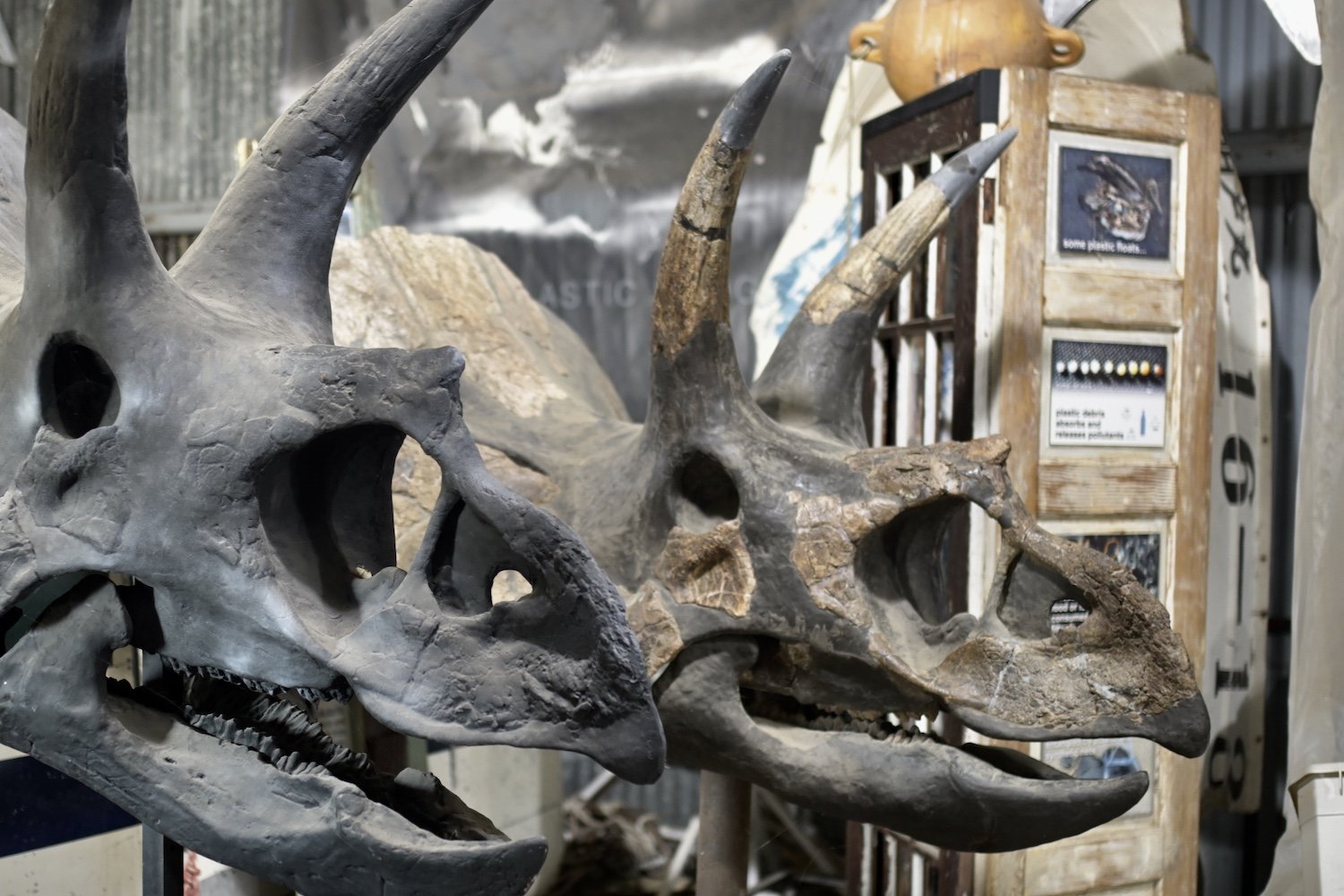
The brown areas on the skull to the right are actual bone fragments. An intricate puzzle.
I get this twisted, inverted grief-feeling when I experience something that’s profoundly meaningful to me, but that I could just as easily have missed. It’s like a wild yearning for something I already have that lasts as long as it takes for me to integrate and claim what is mine. I mean, I am now a person who has handled dinosaur remains. I am now a person who has dinosaur bone fragments on her bookshelf. But what a close call! What if Emma Woods State Beach had had an available spot?
I might never have slept on the plateau of a striped sandstone mountain under a double dome; one an enormous, open-air geodesic dome under which both of our tents fit, along with our makeshift kitchen and dining room, and my hamock, with plenty of room to spare. The other, the dome of night under which shone more stars than I’d thought we’d see, given the light from towns below.The owners of Leap Lab Farm are a couple who have stunning acreage surrounded by the Topa Topa mountains, an astonishing collection of fossils and a passion for public service. They plan to create a Children’s Museum in Santa Paula, a first in the area.
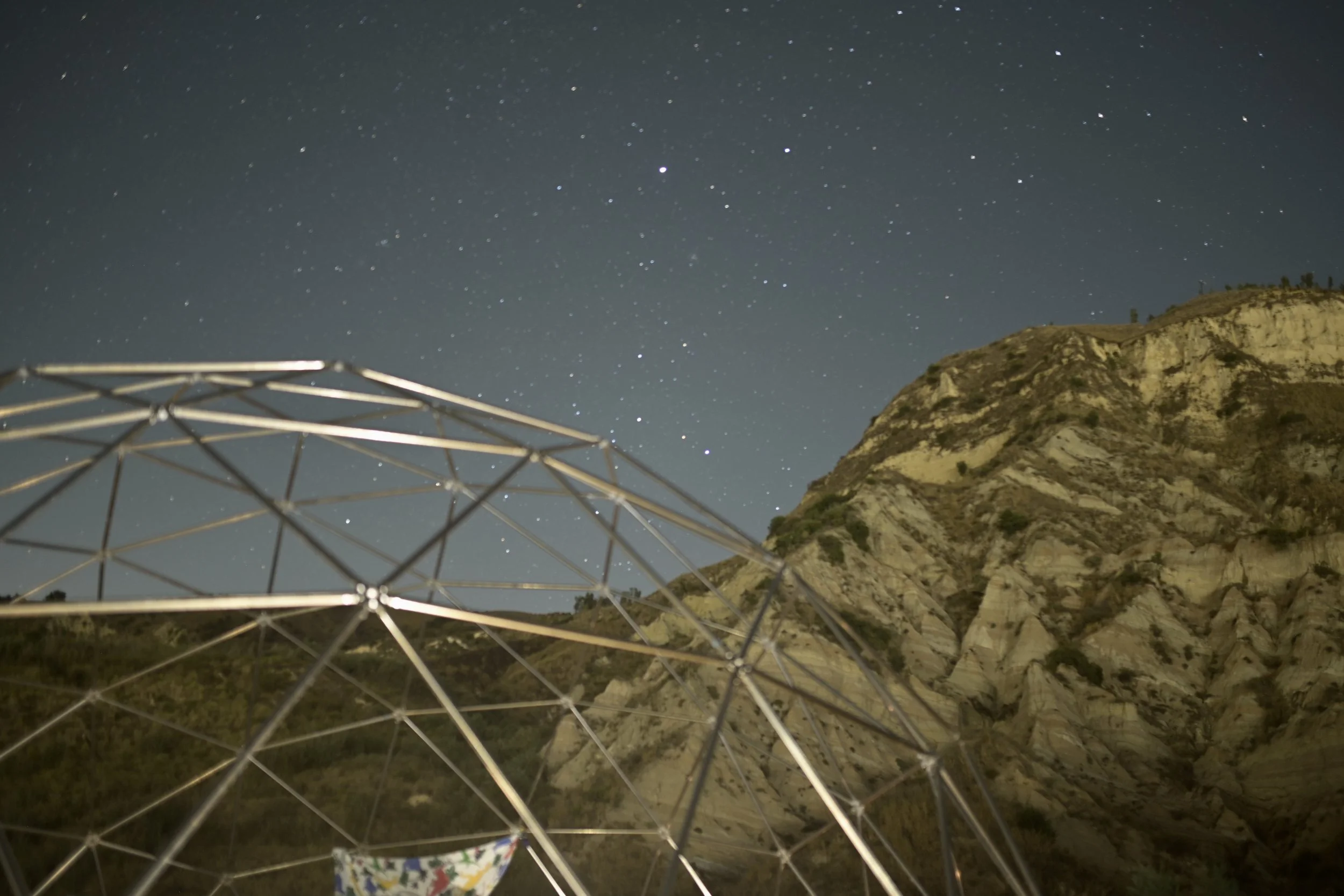
Double Dome
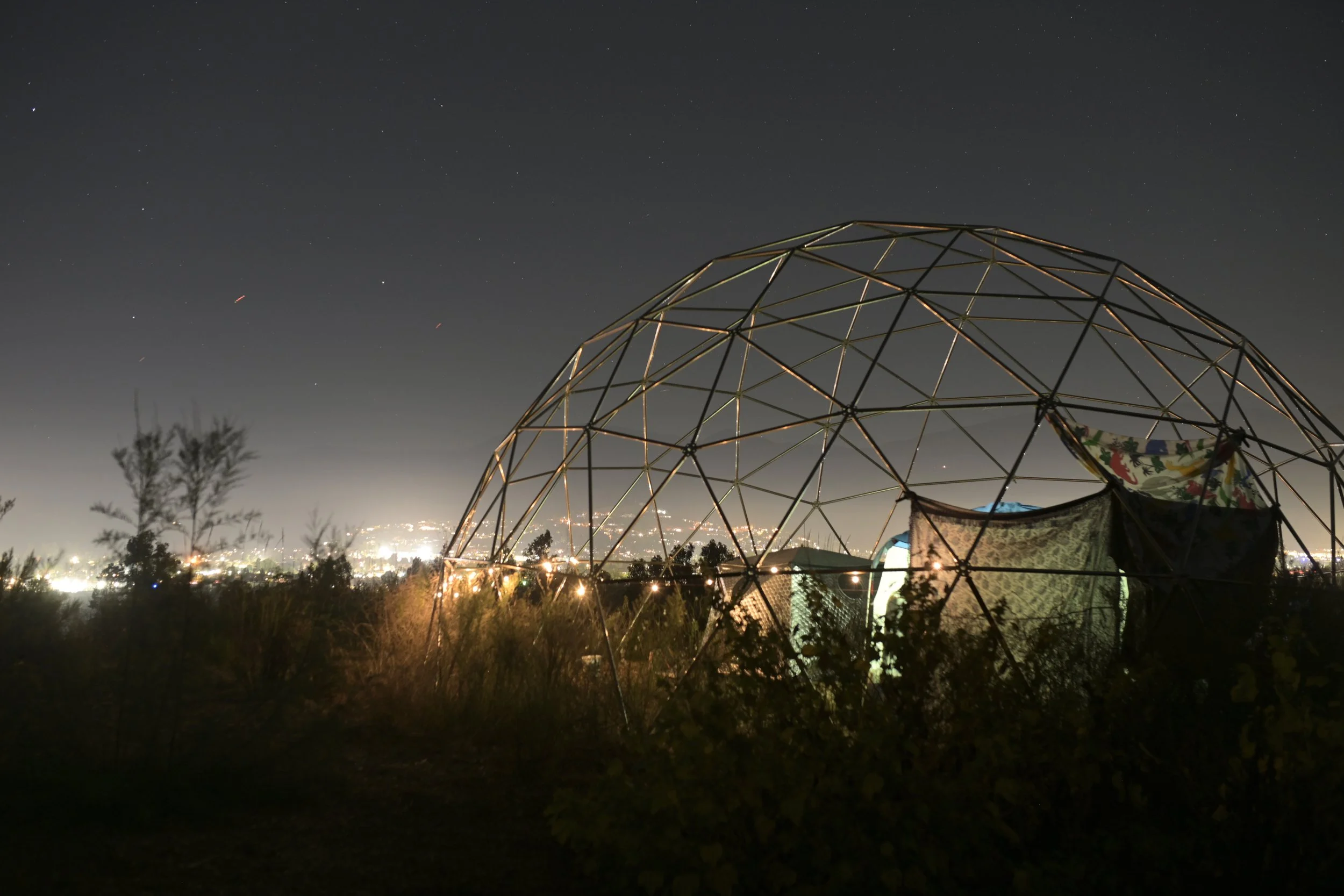
One of our favorite campsites so far
We arrived in the middle of a heat wave that made camp set up a slow, incremental process with breaks taken in any square inch of shade we could find or manufacture.
On day two, after sorting through the tangled spaghetti of crisscrossing freeways and byways, and cursing Siri, whom we normally appreciate greatly, we found our way to 5th street and parked in the exact spot where we’d left off last time we walked in this area, next to a mobile home park called Oxnard Shores and started north with our water bottles, lunches and gear over our shoulders, as always. Ventura County clearly values coastal access, we found bike paths, trials, beaches and walkways that kept us off the highway almost the entire thirty-five miles from Oxnard Shores to the lovely little unincorporated town of Summerland, about five miles south of Santa Barbara.
We were full of phone alarms and good intentions of getting on the road by 4:30 a.m. on each of our walking days so we could avoid high sun, but between unexpected ant invasions, missing coffee filters, the gold-ink-crescent of moon demanding our audience (and that of my camera), and missed exits, we were lucky to be moving our feet along a trail by 6:30 a.m. Accordingly, we ended up walking in the sweltering midday heat. Along the way, Jo found ways to keep cool by asking to borrow people’s garden hoses, stopping at campgrounds and using the sprayer in big, commercial, stainless-steel sinks or, on a few occasions, jumping into the swim at the beach. We wandered along railroad tracks and estuaries. We met a woman out picking herbs along the tracks. She showed us goldenrod and budding white sage and taught us about the properties of these and other plants. She uses the herbs to heal ailments, but this morning she’s simply making a bouquet for her table.
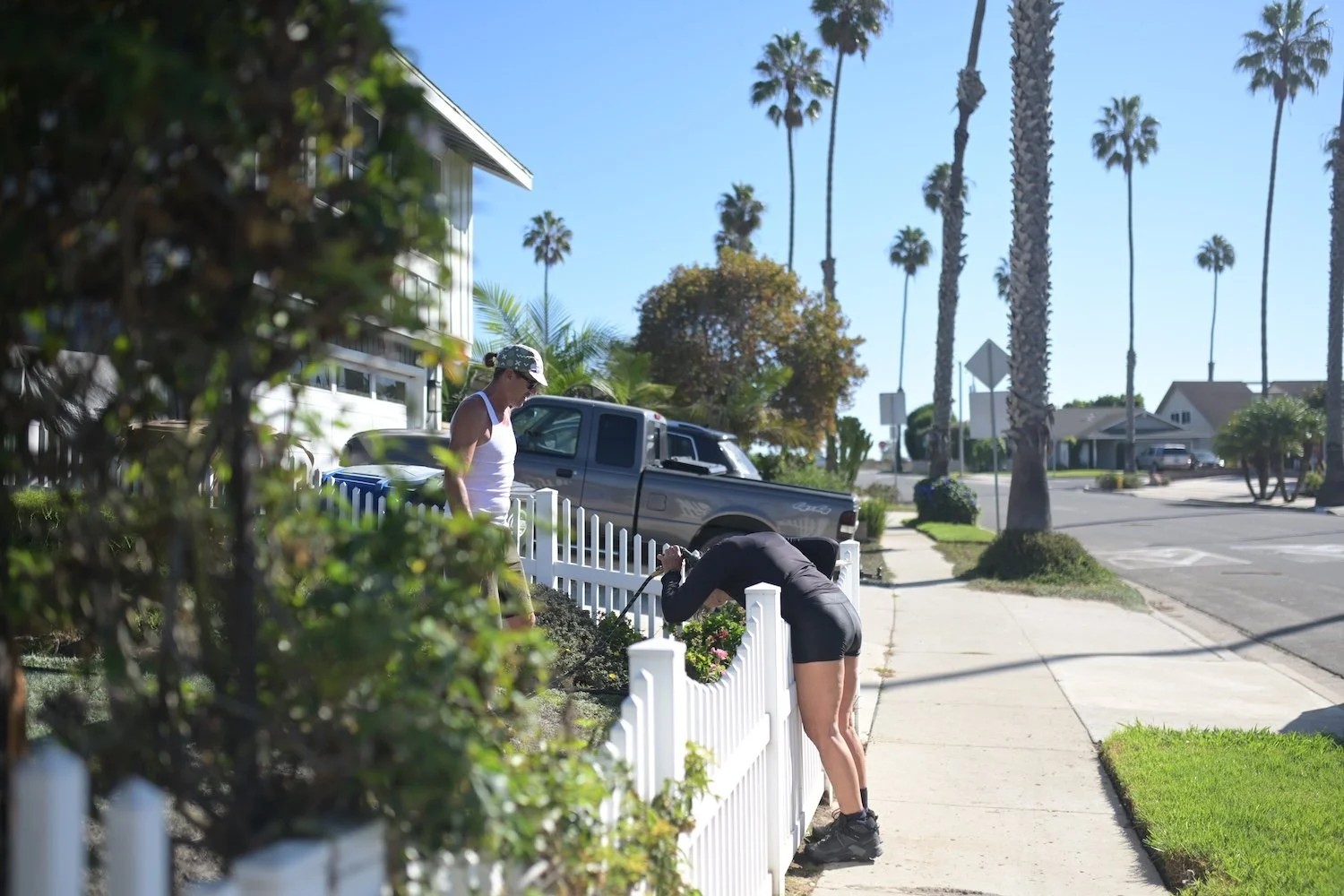
Jo borrows a garden hose to cool off
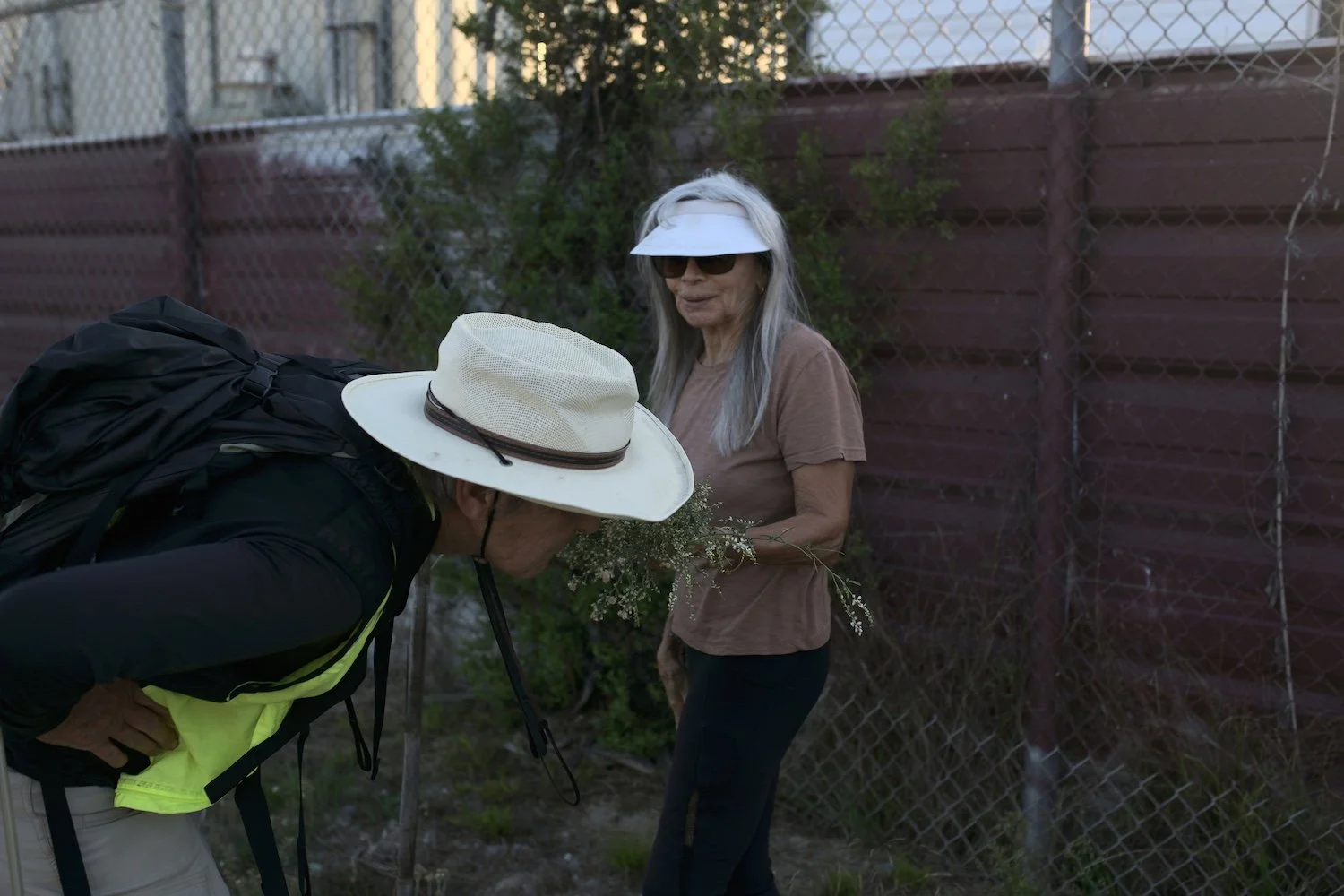
An herbalist we met along the railroad tracks
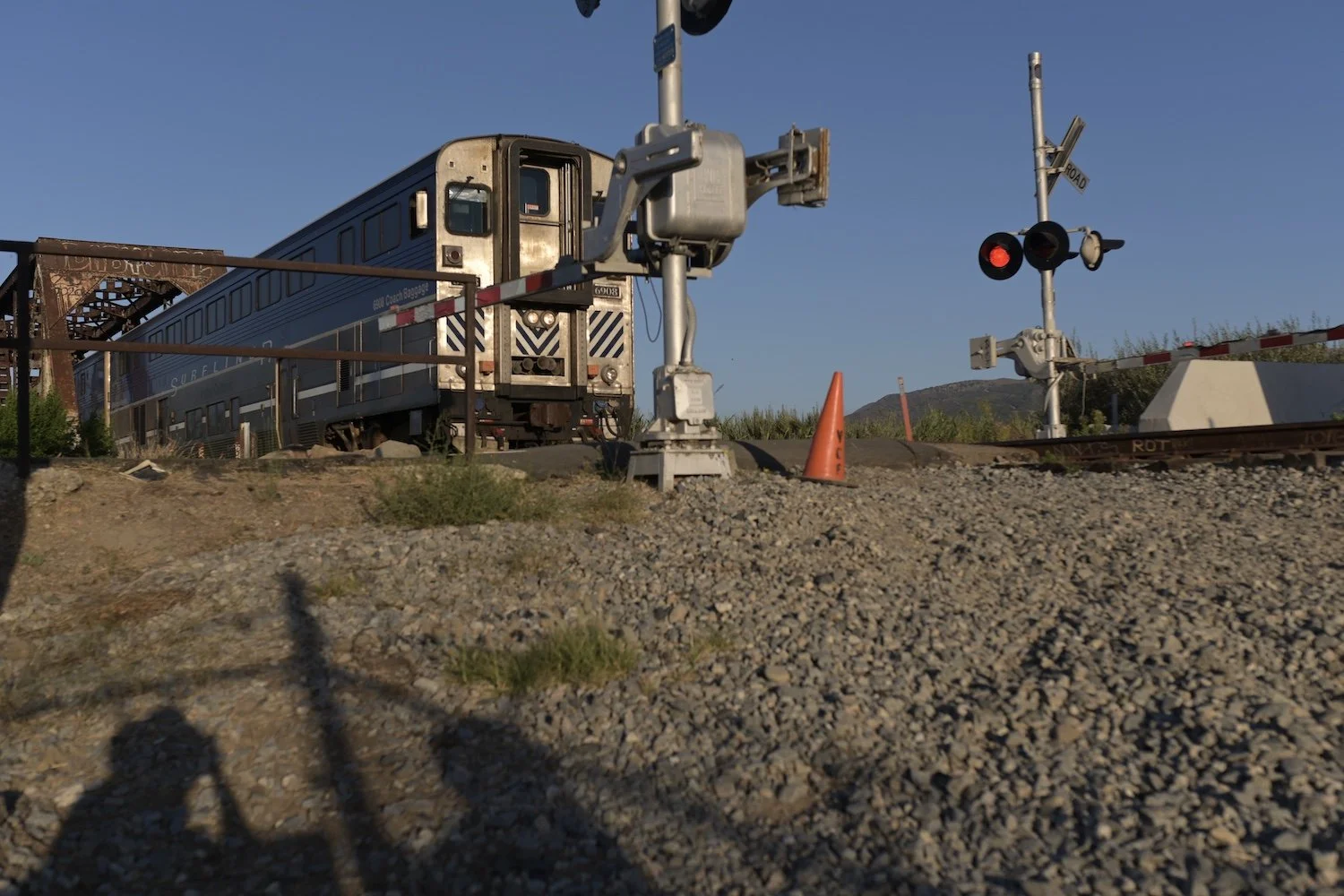
When you hear that whistle blowing…
Within a mile our car at the end of our walk, I took a call from my wife, Ellen, who was overseeing some home improvements. She wanted to discuss the relative merits of two ranges we were considering for our kitchen. As I started explaining that I found one of the stoves markedly more asthetically pleasing then the other, I looked down the stretch of beach and noticed an animal in distress. I cut the conversation short telling Ellen, “I think there’s a dolphin or a shark in the sand. I have to go!” As I drew closer, I could see it was a very small dolphin. A baby.
The urge to help it get back out to sea, back to its mama, was powerful, but I had a vague recollection of reading that you should not touch a stranded sea mammal. Thankfully, I had cell service and was able to contact the local marine mammal rescue center. I was greeted by a prerecorded message and left a voice mail into what felt like a void. I called 911 and implored them to help me get through to the rescue people directly, but they had only the same number I did. I didn’t want to get too close to the animal, so I sat many yards away, but then it felt wrong to just watch it flailing, so I sat closer and spoke to it soothingly. I sat and stood and crouched and paced and fretted.
When I finally got a call back, I learned that a rescuer was on the way, but it was unclear how long it would be. I scoured online sites to see if there was anything at all I could do while waiting. Keep the animal wet. Make sure their blow hole is unobstructed by water or sand. Make sure bystanders and dogs are kept at a distance. Provide shade. It helped to have something I could do. I filled my water bottle up with sea water repeatedly and poured it over the animal. I tried to cast shade by standing between the incoming water and the dolphin, but my shadow was useless with the sun overhead.
I called Jo whom I knew was a distance ahead of me and gave her a status update. As I got off the phone with her, I saw a figure walking toward me. As she came into view, I could see that she was donning latex gloves. But where is the dolphin ambulance?, some childish part of my wondered silently. But where is the funding? A more experienced part of me replied.
I was so distracted by concern for the dolphin, that I’m not sure I caught her name when she introduced herself. I think it was Sage, but I’m not sure she if she said so or if I’m simply remembering her by an obvious attribute. Maybe she was Charity. Or Grace.
She told me that a baby dolphin is found along the Ventura County beaches about once a year. I asked her whether in her experience, the dolphin was likely to survive. Before she could answer, I quickly said, “Never mind, I just want to imagine him being reunited with his mom and frolicking.” She replied, “I totally get it!” I thanked her for her work and started heading toward Jo’s location as “Sage” worked on getting a marine mammal veterinarian on the line for consultation.
I have more focused images of “Sage”, but this one feels more reflective of the moment
As I walked down the beach, A man with his arms full of umbrellas and blankets (for shade) asked me, “Were you with the dolphin? Your friend told me you needed shade.” I pointed him in the right direction, and he headed off to offer help in the rescue effort.
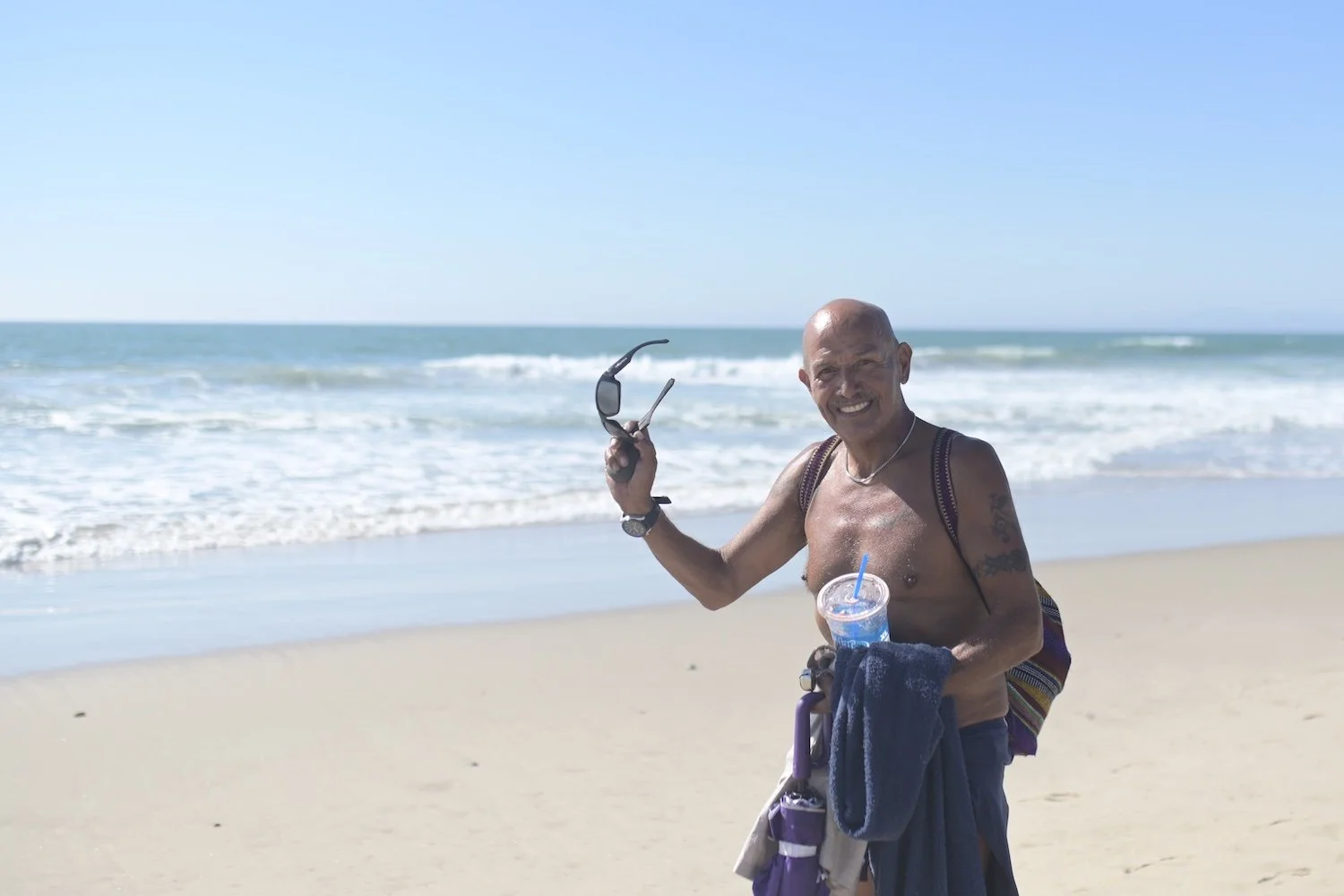
Jo heading down teh beach with shade for the dolphin, dispatched by Jo
In my mind, I named the baby dolphin Ace, my all-time favorite name. The name of my car and my bicycle. The name I try to impose on any person, place or thing I have a chance of helping to name, and many others where my opinion is unlikely to be solicited. I proposed it for our younger son, whom we ultimately named Miles, but was resolutely vetoed by all involved. And anyway, for an avid hiker, “Miles” is a perfect name for a son. Plus, he has become a serious hiker in his own right.
On day four, our last walking day of the trip, we started walking from Wallace Street in the Summerland, heading back to Jo’s car where we’d left it at Emma Wood State Park. We wandered through abandoned campgrounds and long stretches of open beach. The heat was less sweltering each day and there was a sweet, light ocean breeze all morning.
I decided against an alarm clock for day five and slept until the decadent hour of 7 a.m. I packed slowly, reluctant to leave. I lollygagged, writing a few notes about oil drills and dinosaurs and a woman Jo chatted with while we walked along a bike path, who was pushing her dog, whom she named for her late husband, in a stroller.
We are filter feeders just moving through the world, using whatever experiences happen along our path as nutrition.
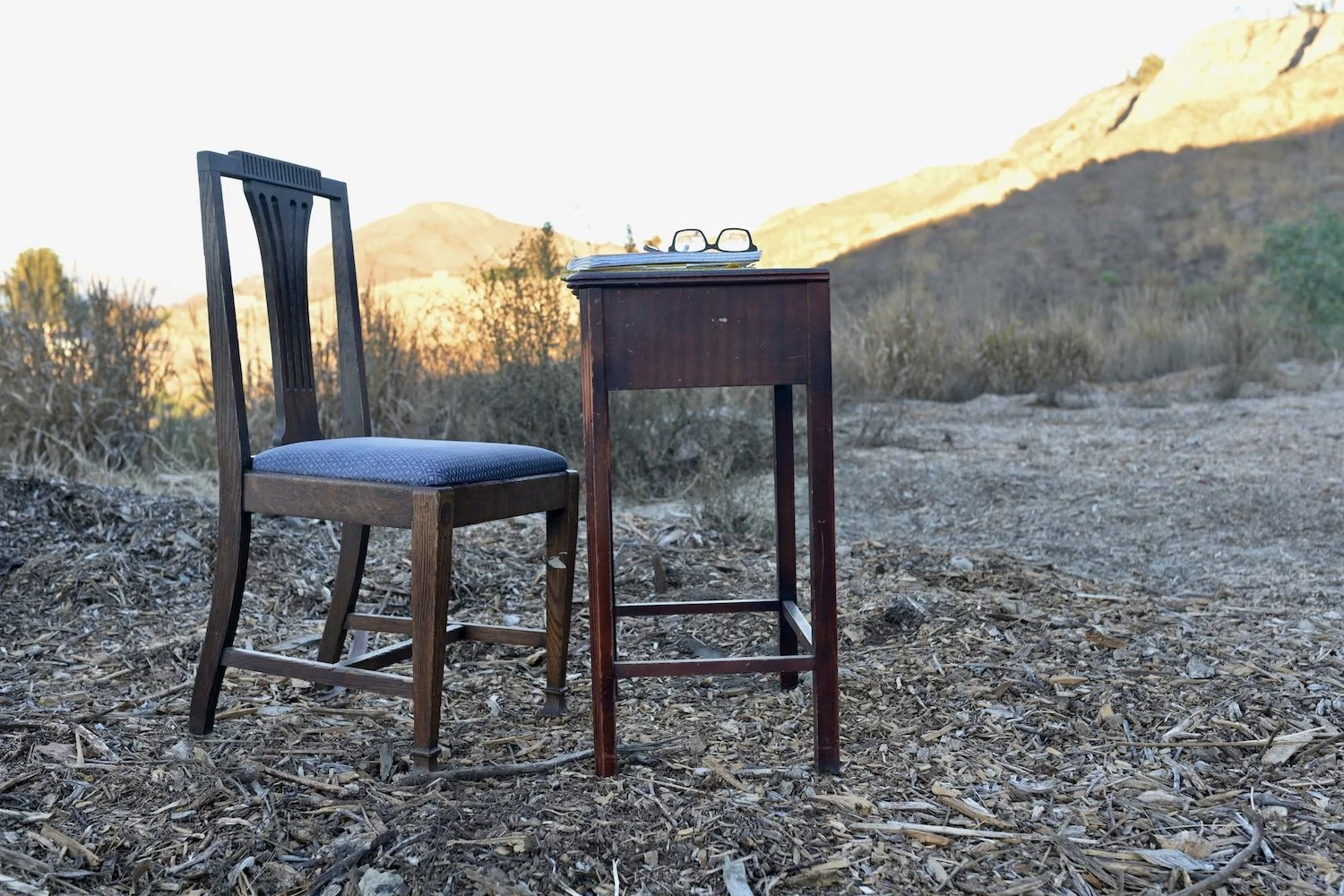
I hope to return to Leap Lab Farm for a little writing retreat
